
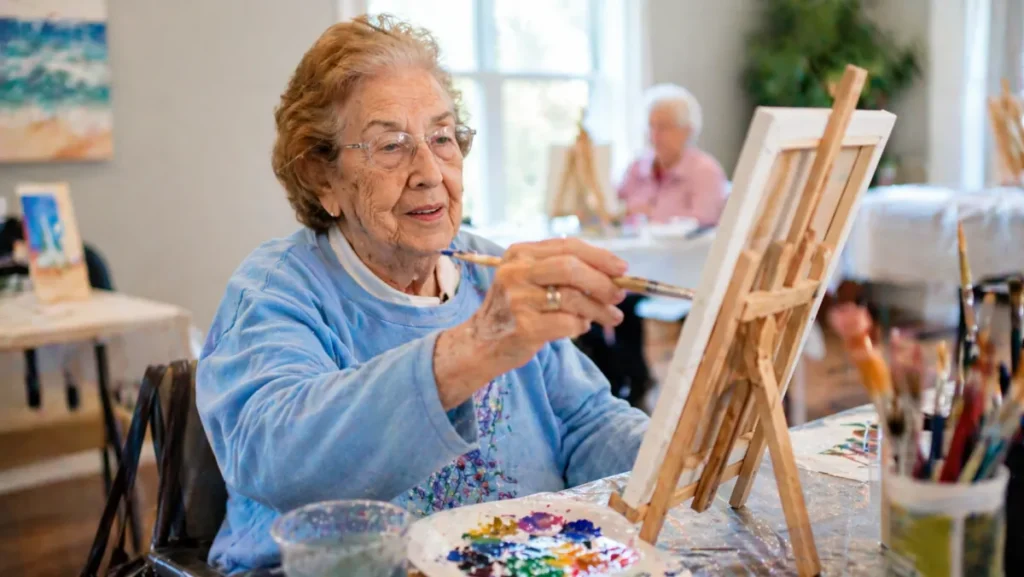
There’s a moment that happens in art studios and music rooms across senior living communities every day. A brush touches canvas. A chord rings out. A poem finds its final line. And something lights up in the person who made it—not just pride, though there’s plenty of that. Something deeper. A reminder that this is still possible. That growth, expression, and joy don’t carry an expiration date.
For older adults and the families who love them, creativity in senior living is far more than a pleasant way to pass an afternoon. Research increasingly shows that engaging in creative activities supports cognitive health, emotional resilience, and social connection in ways that are genuinely life-changing. And today’s senior living communities—from independent living to assisted living to memory care—are taking notice, weaving robust creative programming into the very foundation of resident life.
Whether you’re exploring options for yourself or helping a loved one navigate this transition, this guide will walk you through everything you need to know: why creativity matters so profoundly as we age, what kinds of creative activities for seniors are available in today’s communities, and how to recognize a community that treats the arts as essential rather than optional.
Why Creativity Matters More as We Age
Most of us grow up thinking of creativity as a talent reserved for artists, musicians, and writers. Research has reframed it as something far more universal—and far more vital to healthy aging. Creativity is closely tied to the personality trait of openness: curiosity, flexibility, and a willingness to remain engaged with the world. Studies have linked this trait to greater longevity and better quality of life in older adults.
The National Institute on Aging has identified arts participation as one of the foundations of healthy aging, finding that creative engagement can enhance well-being and contribute to a longer, more fulfilling life. Research published in Today’s Geriatric Medicine found that making art can reduce depression and anxiety—symptoms that often accompany chronic illness in later life. Studies show that seniors who engage regularly in creative pursuits report higher life satisfaction, greater confidence, and a stronger sense of purpose.
What’s easy to miss in all of this data, though, is the human reality behind it. Retirement, health changes, and the loss of familiar roles can quietly narrow a person’s world. When someone leaves a career, moves from a longtime home, or loses a spouse, they may also lose the daily structures that gave life meaning and identity. Creativity steps into that space. It offers a way to say: I am still here. I still have something to make, to say, to share.
It’s also worth pausing on what creativity is not required to be. You don’t need to be artistic to benefit from creative expression. Creativity shows up in the way you arrange flowers on a table, the story you tell at dinner, the sweater you knit for a grandchild. When senior living communities genuinely understand this, they stop gatekeeping their creative programs and start opening the door wide—to everyone.
What the Research Says About Creativity and Older Adults
A growing body of evidence supports what many residents, caregivers, and families have long observed firsthand. Studies show that regular creative activities for seniors:
- Reduce anxiety and improve mood, including in older adults managing chronic illness
- Increase life satisfaction and a sense of personal empowerment
- Boost self-esteem and confidence, particularly in group creative settings
- Support emotional resilience by encouraging patience, self-compassion, and curiosity
- Are linked to greater longevity when woven into regular daily life
The Cognitive Benefits of Creativity for Seniors
Creative activities engage the brain in ways that few other pursuits can match. Painting, playing an instrument, writing, or learning a new craft simultaneously activates memory, coordination, problem-solving, and attention—challenging the brain to make new connections and stay agile. Unlike passive entertainment, active creative participation demands focus and engagement. Learning a new technique, remembering the steps of a process, or figuring out how to execute an artistic vision all require the kind of effortful thinking that supports long-term cognitive function.
This distinction matters. Watching television and attending a watercolor class may both fill an afternoon, but only one of them asks the brain to do something genuinely challenging. For older adults, that difference accumulates meaningfully over time.
Can Art and Creativity Improve Memory in Older Adults?
Yes—and the research is compelling. Studies show that creative activities support memory and cognitive function in several distinct ways:
- Reminiscence and storytelling—Writing personal narratives, creating memory books, or participating in guided art projects encourages seniors to access and organize long-term memories, which exercises cognitive function in meaningful ways.
- Learning new skills—Picking up a paintbrush for the first time at 75 challenges the brain to form new neural pathways, a process neuroscientists call neuroplasticity. Studies show that the brain remains capable of this kind of growth well into old age.
- Music and memory—Music has a particularly powerful relationship with memory. Research from the Music & Memory program has documented cases in which residents who were largely non-communicative became animated, engaged, and expressive when listening to personally meaningful songs—even in moderate to advanced stages of dementia.
For seniors experiencing early cognitive changes, creative activities offer a gentle, joyful way to stay mentally engaged—without the pressure of a test or a task.
How Creative Activities Support Brain Health Long-Term
Consistency is key. Studies suggest that regular engagement in creative pursuits—even just a few minutes each day—may slow the progression of cognitive decline over time. The mechanism is straightforward: a brain that is regularly challenged, stimulated, and asked to learn remains more resilient than one that is not.
This is why the frequency of creative programming in a senior living community matters just as much as its variety. A community that offers creative activities daily—woven into the rhythm of ordinary life—provides something fundamentally different from one that schedules a craft class once a week.
The Physical Benefits of Staying Creative
It’s worth noting that the benefits of creativity in senior living aren’t limited to the brain and the emotions. Many creative activities carry meaningful physical benefits as well:
- Dance and movement improve balance, coordination, and cardiovascular health—reducing fall risk while delivering genuine joy
- Painting and drawing maintain fine motor skills and hand-eye coordination
- Singing and choral programs strengthen respiratory function and breath control
- Gardening combines gentle physical activity with sensory engagement and a connection to the natural world
- Knitting and needlework support dexterity and joint mobility in the hands and fingers
For families evaluating communities, asking how creative programs support physical health—not just mental and emotional health—is a question worth adding to the list.
Emotional and Mental Health Benefits of Creative Expression
Creative activities give form to feelings that might otherwise be difficult to name or express. The act of painting, sculpting, writing, or moving to music offers a release valve for emotions that accumulate quietly: grief, uncertainty, the frustration of physical limitations, the longing for people and places left behind.
Research consistently shows that creative engagement lowers stress hormones, improves mood, and provides a sense of accomplishment that feeds self-worth. And perhaps most powerfully, it builds emotional resilience—the ability to face difficulty with patience and grace—by giving seniors a regular practice of showing up, trying, and creating something that wasn’t there before.
Types of Creative Activities Offered in Senior Living Communities
The range of creative offerings in today’s retirement communities is broader and richer than many families realize. Here’s a look at the landscape—and a reminder that this list is not exhaustive. The best communities will surprise you.
Visual Arts—Painting, Drawing, and More
Visual arts programs are among the most widely offered in senior living communities, and for good reason. Painting, drawing, and mixed media are accessible, adaptable, and deeply rewarding—and they can be modified for residents of virtually any physical ability level.
| Activity | Key Benefits | Adaptations Available |
| Watercolor & acrylic painting | Fine motor skills, focus, self-expression | Adaptive brushes, seated easels |
| Drawing & sketching | Observation, mindfulness, concentration | Large-grip tools, tabletop surfaces |
| Sculpture & pottery | Tactile engagement, spatial thinking | Guided hand-over-hand support |
| Photography | Environmental engagement, tech confidence | Tablet cameras, large-button devices |
| Collage & mixed media | Accessible to all skill levels | Pre-cut materials, simplified formats |
Many communities partner with local artists or art schools to bring professional instruction into the community—elevating the experience and exposing residents to new techniques, perspectives, and creative possibilities.
Music, Dance, and Performing Arts
Music occupies a unique place in creative programming because it reaches people across the full spectrum of cognitive and physical ability. A resident who cannot easily hold a paintbrush may still close their eyes and find their way back to a song from 1962—and feel, in that moment, completely themselves.
- Group sing-alongs and choir build social bonds and improve respiratory function
- Music appreciation programs encourage active listening, memory, and joyful discussion
- Dance and movement classes support balance, coordination, and cardiovascular health alongside creative expression
- Theater and reader’s theater offer performance opportunities for those who love the dramatic arts—no memorization required
Crafts, Culinary Arts, and Everyday Creativity
Creativity doesn’t always announce itself as “art.” Some of its most meaningful expressions happen in quieter moments—and in senior living communities, these everyday forms of creative engagement are just as valuable as any structured class.
- Knitting, crocheting, and needlework—tactile, portable, meditative, and deeply social (knitting circles have been community institutions for centuries)
- Seasonal crafts and holiday décor-making—tied to traditions, memory, and the rhythms of the year
- Cooking demonstrations and culinary creativity—engaging all the senses while connecting to cultural heritage and personal history
- Gardening and floral arranging—nurturing living things, engaging with the natural world, creating beauty from the ground up
- Personal space and personal style—encouraging residents to decorate their own apartments, choose their own clothes, and express their identities through their everyday environment
That last point matters more than it might seem. Autonomy in self-expression—the freedom to arrange your own space, wear what you love, cook a dish from memory—is a form of dignity. Communities that honor this understand something important about what it means to truly care for a person.
How Senior Living Communities Encourage and Support Creativity
There is a meaningful difference between a community that offers creative activities and one that genuinely cultivates a creative culture. Families can learn to tell them apart—and the distinction is worth understanding before you tour.
Dedicated Programming and Life Enrichment Teams
Communities that take creativity seriously invest in the people who make it possible. This means:
- Dedicated life enrichment or activities directors with training in therapeutic recreation, expressive arts, and person-centered programming
- Robust activity calendars with creative offerings throughout the week—not just a single craft afternoon
- Partnerships with local artists, musicians, cultural institutions, and schools that bring fresh instruction and intergenerational energy into the community
- Culturally responsive programming that reflects the backgrounds, traditions, and personal histories of the residents who actually live there—including culturally specific offerings such as kosher culinary programming, language-specific literary groups, or music rooted in residents’ cultural heritage
When touring a potential community, ask to see a recent activity calendar. Look for variety, frequency, and evidence that programming is genuinely built around the people who live there—not a generic template applied equally to every resident.
Creativity Across All Levels of Care
One of the most important things families should understand—and one of the least discussed—is that creative programming should not be exclusive to residents of independent living. Creativity is equally valuable and equally possible across every level of care. If a community’s creative offerings disappear the moment a resident transitions to assisted living or memory care, that is a gap worth taking seriously.
Creativity in Assisted Living Communities
In assisted living communities, thoughtful, creative programming is adapted to meet residents where they are—physically, cognitively, and emotionally. Staff trained in adaptive techniques modify activities so that every resident has a meaningful way to participate: pre-cut materials for a collage project, adaptive brushes for a resident with limited grip strength, a simplified knitting pattern, or simply sitting alongside someone and creating together.
The goal is never performance. It is participation. And participation—at any level, in any form—delivers the same core benefits: joy, connection, purpose, and dignity.
The Role of Art in Memory Care
In memory care settings, creative activities take on an additional layer of clinical and emotional significance. Art therapy, music therapy, and movement programs are used as structured interventions that support residents living with Alzheimer’s disease and other forms of dementia—reducing agitation, improving mood, and creating moments of genuine connection even when verbal communication has become limited.
Music, in particular, has shown a remarkable ability to access memory and emotion in individuals with moderate-to-advanced dementia. Research from the Music & Memory program has documented cases in which residents who were largely non-communicative became animated, expressive, and fully present when listening to personally meaningful music. These are not small moments. For families who haven’t seen their loved one that present in months, they can feel like miracles.
For families navigating a memory care decision, asking about creative and arts-based programming is not a secondary question. It is a primary one.
What to Look for in a Senior Living Community’s Creative Programming
Creative programming quality varies widely across retirement communities and assisted living communities. A few specific, well-placed questions during a tour can reveal a great deal about what a community truly values.
Questions to ask on a tour:
- How often are creative activities offered each week?
- Are programs led by trained staff or certified art and music therapists?
- How are activities adapted for residents with limited mobility or cognitive changes?
- Does the community partner with local artists, musicians, or cultural organizations?
- Are there dedicated creative spaces, or do activities happen in general common areas?
- How does the community incorporate residents’ individual cultural backgrounds and personal histories into its programming?
- Is creative programming available across all levels of care—including assisted living and memory care?
What strong communities look like versus communities that fall short:
| Green Flags | Red Flags |
| Rich, varied calendar with multiple creative offerings per week | Vague answers: “We have lots of things going on” |
| Resident artwork displayed throughout the community | Calendar heavy on passive entertainment, light on active creation |
| Staff who speak specifically and enthusiastically about programs | No dedicated spaces for creative activities |
| Programming that reflects residents’ cultural backgrounds | Identical programming regardless of care level |
| Creative activities available in assisted living and memory care | Creative programs available only to independent living residents |
| Partnerships with local artists, schools, or cultural organizations | No outside partnerships or community connections |
Creativity Is at the Heart of a Life Well Lived
The evidence is clear—but the truth behind it is even clearer to anyone who has watched a senior resident step back from a finished painting with quiet satisfaction, or heard a room full of voices rise together in a song they’ve all carried for sixty years. Creativity in senior living isn’t a luxury. It isn’t an amenity listed in a brochure. It is one of the ways human beings stay alive in their own lives—curious, engaged, connected, and purposeful.
For older adults, the opportunity to create is an opportunity to say: I am still here. I still have something to offer. My story is still being written.
The communities that understand this don’t just schedule creativity. They build their entire culture around it.
Experience Creativity Every Day at Cura Living
At Cura Living, we believe that a well-lived life doesn’t slow down after retirement—it evolves. And we believe that creativity, self-expression, and meaningful engagement aren’t programs to be scheduled. They’re values to be lived.
Our communities are designed around the whole person: body, mind, and spirit. Our life enrichment teams work closely with each resident to understand their individual history, interests, and passions—and to build programming that reflects who they actually are, not a generalized idea of who a resident of a senior living community is supposed to be. Whether someone has painted for decades or has never picked up a brush, they’ll find a welcoming, encouraging environment where showing up is more than enough to get started.
We’re proud to offer culturally responsive programming that honors the backgrounds and traditions of the individuals in our communities—including kosher dining and culturally sensitive services at our Boca Raton community, where the details of who you are and how you’ve lived your life genuinely matter to us.
Everyone says they treat residents like family. We’d rather you feel that for yourself.
Your next step is simple: reach out to the Cura Living team to ask questions, request information about our communities and creative programming, or schedule a personal tour. Come see the art on the walls. Listen for the music in the hallways. Meet the people who live and work here. Because the most important thing we can tell you about Cura Living is best experienced in person.