
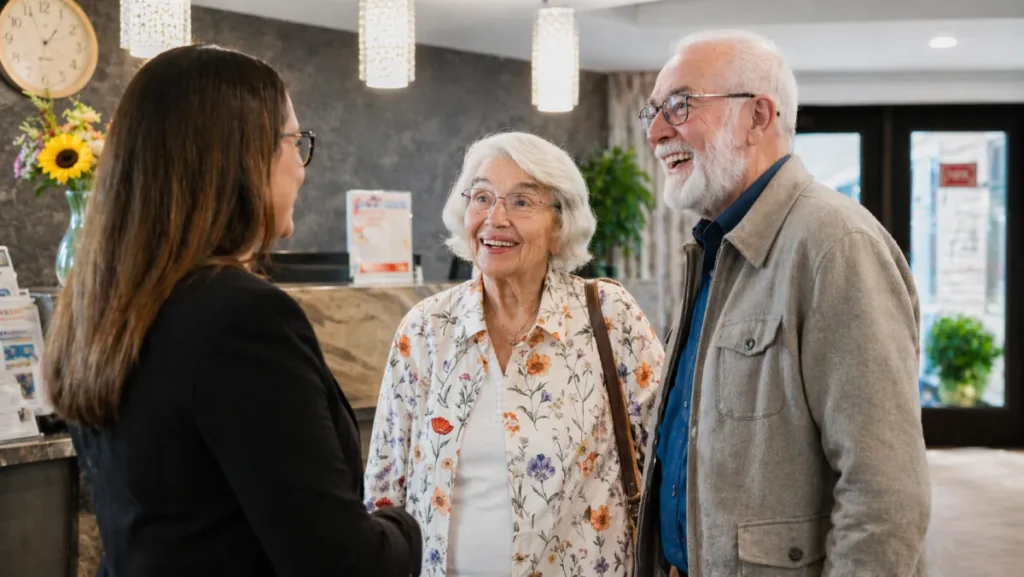
Choosing an assisted living community for someone you love is one of the most significant decisions a family will ever make. It is also one of the most emotional. You may be navigating grief, guilt, relief, and hope—sometimes all in the same afternoon. Touring an assisted living community in person is the single most important step you can take to cut through the noise, calm the anxiety, and find a place that truly feels right.
But a tour without preparation is just a walk through a building. This guide is designed to change that. Whether you are an adult child researching options for an aging parent, or a senior exploring communities for yourself, you will leave this article knowing exactly what to look for, what questions to ask, and which warning signs to take seriously—so that when you walk into a community, you walk in ready.
Why Touring an Assisted Living Community in Person Matters
What You Cannot Learn From a Website or Brochure
Every assisted living community has a polished website with soft lighting, smiling residents, and a list of amenities that sounds nearly identical to the one next door. Brochures are curated. Photography is staged. None of that tells you whether the dining room smells welcoming or institutional, whether the staff greet residents by name without prompting, or whether the people who live there appear genuinely content.
The intangibles—atmosphere, warmth, whether residents are engaged or withdrawn—are only visible in person. A community tour is your opportunity to experience a place’s culture, not just its square footage.
How Many Communities Should You Tour?
Senior living experts consistently recommend touring at least three communities before making a decision. Visiting multiple communities calibrates your sense of what “good” actually looks like—you cannot fully appreciate an exceptional community until you have seen a mediocre one.
Schedule tours at different times of day. A community can look different at 10 a.m. on a Tuesday than it does at 4 p.m. on a Friday. And consider a follow-up visit—unannounced, if possible—after your initial tour. Arrive during a meal or a shift change. The way a community operates when it is not expecting you is the most honest version of itself.
How to Prepare Before Touring an Assisted Living Community
Know Your Loved One’s Current and Future Care Needs
Before you tour a single building, understand which level of care your loved one currently needs—and realistically anticipate where those needs may go over the next several years. Most communities offer three core levels:
- Independent living: For seniors who are largely self-sufficient but want community, convenience, and on-site support available.
- Assisted living: For seniors who need help with some activities of daily living (ADLs) such as bathing, dressing, medication management, or mobility.
- Memory care: Specialized care for individuals living with Alzheimer’s disease, dementia, or other cognitive conditions requiring a secure and structured environment.
Some communities also operate as Continuing Care Retirement Communities (CCRCs), offering all three levels under one roof. If your loved one may need a higher level of care in the future, a CCRC can eliminate the disruption of relocating—a significant consideration for families planning long-term.
Understanding these distinctions shapes every question you ask on your tour.
Prepare Your Touring Checklist Before You Go
Write down your questions in advance. Bring a notepad or use your phone to record observations—you will be surprised how quickly the details from one community blur with the next. Consider who comes with you: a second family member, a trusted friend, or even a professional geriatric care manager can notice things you may miss and ask questions you may not think of in the moment.
Questions to Ask About Care Plans and Levels of Care
How Are Individual Care Plans Created and Updated?
A quality assisted living community should never treat residents as interchangeable. Ask how the community develops individualized care plans. Who is involved—the resident, family members, nursing staff, physicians? How frequently are plans reviewed and updated? What triggers a reassessment?
The answer you are looking for reflects genuine partnership. Care plans should evolve with the person, not remain static documents filed away and forgotten.
What Happens If a Resident’s Care Needs Increase?
This is one of the most important questions families overlook—and one of the most consequential. You need to understand, in clear terms, what happens if your loved one’s needs change. Can the community accommodate higher levels of care, including memory care? Or would your loved one need to relocate to a different community?
Relocating a senior with advancing cognitive decline is deeply disruptive. Understanding whether a community can support your loved one in aging in place can save enormous emotional and logistical hardship later.
Questions to Ask About Memory Care Specifically
Memory care is not simply assisted living with a locked door. Communities that do it well invest in trained staff, purpose-designed spaces, and programming grounded in evidence-based dementia care approaches. If memory care is a current or potential future need, it deserves dedicated attention during your tour. Key questions include:
- Is memory care offered in a dedicated, secured wing or unit?
- What specialized training do memory care staff receive?
- How does the community handle behavioral expressions of dementia, such as agitation or wandering?
- What structured programming exists specifically for residents with cognitive impairment?
- How does the community communicate with families about changes in a resident’s condition?
Questions to Ask About Staff Members and Staffing
What Are the Staff-to-Resident Ratios?
Ask for specific numbers—not approximations. What is the ratio during the day? At night? On weekends? Staffing ratios are among the clearest indicators of the amount of individual attention a resident will receive. The National Center for Assisted Living notes that staffing expectations vary significantly by state, which means a community can be technically compliant while still being understaffed for its actual resident population.
How Are Staff Members Trained and Credentialed?
Ask about orientation for new hires, ongoing education requirements, and any specialized certifications held by staff. Is there a licensed nurse on-site 24/7, or only on call? Who supervises direct care staff? The team’s qualifications directly impact the quality and safety of your loved one’s daily experience.
What Is the Staff Turnover Rate—and Why Does It Matter?
This question makes some tour guides visibly uncomfortable. Ask it anyway.
High turnover is one of the most reliable warning signs in senior living. When staff leave frequently, residents lose the continuity and familiarity that makes a place feel like home. It also signals potential issues with management culture, compensation, or working conditions.
A trustworthy community will answer this question honestly. If the answer is evasive, that is information too.
As a follow-up, ask: Why do people leave? And then: Why do your best staff stay? That second question often reveals more about a community’s culture than any formal answer.
How Does the Community Welcome and Orient New Residents?
The first weeks in a new community can profoundly shape how a resident feels about living there. Ask about the formal processes for welcoming newcomers. Are there introductions to neighbors and staff? Is there a designated person—a “buddy” resident or staff member—responsible for helping someone settle in? Is the resident’s background, preferences, and personality explored before or shortly after move-in?
A community that invests in the transition period understands that moving is hard—and takes deliberate steps to make it less so.
What to Observe During the Tour—Beyond the Sales Pitch
Read the Room: Observing Resident Happiness and Engagement
Pause. Look past the tour guide. Watch the residents.
Are they engaged with one another? Do staff members greet them by name, make eye contact, or stop to exchange a word? Or do staff move briskly past residents as if on a tightly choreographed schedule that leaves no room for human connection?
You are not looking for performative happiness. You are looking for ease—the quiet, unremarkable comfort of people who feel at home.
Evaluating Cleanliness, Maintenance, and Overall Upkeep
Walk slowly. Notice:
- Odors: A well-managed community should smell clean and neutral, not heavily masked with air freshener (which can be a warning sign in itself). Persistent unpleasant odors suggest maintenance or hygiene lapses.
- Condition of common areas: Are the carpets worn? Is furniture dated or damaged? Are public restrooms clean?
- Outdoor spaces: Are gardens maintained? Are residents actually using the outdoor areas, or are they largely decorative?
- Overall upkeep: Small maintenance details (a burned-out hallway light, a scuffed wall that has been that way for a long time) can reflect a broader approach to standards.
Touring the Actual Living Spaces
Do not limit your tour to the lobby and the dining room. Ask to see a representative apartment or room—ideally one that is not a model unit staged for tours. If possible, ask to see a space similar in layout and size to what your loved one would occupy.
Pay attention to:
- Square footage and layout: Is there enough room for familiar furniture and personal belongings?
- Natural light: Does the unit feel bright and livable or institutional and dim?
- Accessibility features: Grab bars in the bathroom, wide doorways for walkers or wheelchairs, emergency pull cords or call buttons, and non-slip flooring.
- HVAC and climate control: Can residents adjust their own temperature?
- Storage: Is there adequate closet and cabinet space?
- Privacy: For shared rooms, how is privacy managed?
- Personalization: Can the resident bring their own furniture, artwork, and belongings? Are there restrictions?
The living space is where your loved one will spend the majority of their time. It deserves your full attention.
Questions to Ask About Safety Measures and Emergency Protocols
What Security and Safety Systems Are in Place?
Ask about access control: how does the community manage who enters and exits the building? Are there cameras in common areas? How are visitors logged? For memory care units, ask specifically about anti-wandering systems such as door alerts or wearable devices.
How Does the Community Handle Medical Emergencies?
Ask directly:
- Is a licensed nurse on-site 24 hours a day?
- What is the protocol when a resident falls, has a seizure, or experiences a cardiac event?
- How does the community manage medications—who administers them, and how are errors tracked and prevented?
- Does a pharmacist oversee the medication program to check for adverse interactions?
- What relationships does the community have with nearby hospitals or emergency services?
The answers to these questions are not merely procedural. They describe what your loved one’s safety net looks like at 2 a.m. on a Sunday.
What Happens During a Natural Disaster or Power Outage?
This question is almost never asked on assisted living tours—which is precisely why you should ask it. Does the community have a written emergency preparedness plan? Is there a backup generator? What is the evacuation protocol? How are families notified during a crisis?
A community that has thought carefully about emergency preparedness—and can speak to it confidently—is one that takes resident safety seriously as an operational priority, not just a marketing talking point.
Questions to Ask About Dining Options and Nutrition
What Does Daily Dining Look Like?
Food is one of the most important factors in a resident’s quality of life and daily satisfaction. Ask about meal frequency, dining room hours, and whether residents have flexibility in their meal times. Are snacks available between meals? Can residents choose where they sit, or is seating assigned?
The dining experience also reveals much about a community’s social culture. Mealtimes are when connection happens. A lively, pleasant dining room is a good sign.
How Are Dietary Restrictions and Special Needs Accommodated?
Ask specifically about the community’s ability to accommodate:
- Diabetic, low-sodium, and heart-healthy diets
- Texture-modified diets for residents with swallowing difficulties
- Food allergies and intolerances
- Cultural or religious dietary requirements, including kosher or halal meals
Communities that handle these accommodations with care and consistency demonstrate a genuine commitment to individualized wellbeing—not just a one-size-fits-all approach to nutrition.
Can You Have a Meal During Your Tour?
If at all possible, ask to eat a meal at the community you are considering. No other single experience will tell you more about the dining program. Taste the food. Observe the dining room during service. Notice how staff interact with residents at the table. Is it rushed, or is mealtime treated as a meaningful part of the day?
Many communities will accommodate this request. If a community declines without explanation, that itself is worth noting.
Questions to Ask About Amenities, Activities, and Daily Life
What Social and Recreational Activities Are Offered?
Ask to see the current activities calendar—not a generic brochure, but what is actually scheduled this week. Look for variety across categories:
| Activity Type | Examples |
| Physical | Fitness classes, walking groups, yoga, aquatic therapy |
| Creative | Art, music, pottery, gardening |
| Cognitive | Book clubs, trivia, lectures, lifelong learning programs |
| Social | Happy hours, game nights, community outings |
| Spiritual | Worship services, meditation, chaplaincy programs |
Also ask: Do residents have a voice in what activities are offered? Communities that invite resident input tend to run programming that actually reflects the interests of the people who live there.
What Amenities and Services Are Available On Site?
A thoughtful range of on-site amenities reduces the logistical burden on families and supports residents’ independence. Ask about:
- Transportation for medical appointments and outings
- Beauty and barbershop services
- Fitness centers and wellness programming
- Outdoor spaces, gardens, or walking paths
- Chaplaincy or spiritual care services
- On-site therapy (physical, occupational, speech)
Questions to Ask About Costs, Contracts, and Financial Assistance
What Is Included in the Base Monthly Rate?
Get this in writing, and go line by line. Many families are surprised to discover that services they assumed were included—medication management, incontinence care, transportation, laundry—are actually billed as add-ons. Common examples of fees that may not be bundled into the base rate include:
- Personal laundry (versus community linens)
- Medication administration (versus medication storage only)
- Escort to meals or activities
- Higher levels of personal care assistance
- Guest meals
- Utilities, cable, and internet
Understanding the full cost picture upfront prevents painful surprises and allows for accurate financial planning.
How Are Rate Increases Handled?
Ask how often the community has raised rates in the past three years, and by approximately what percentage. Is there a cap on annual increases? What triggers a mid-year rate change (for example, a change in care level)?
This conversation is not adversarial—it is prudent. Senior living costs are a long-term financial commitment, and understanding the trajectory of fees is as important as understanding the current price.
Does the Community Accept Medicaid or Offer Financial Assistance?
This is a question many families hesitate to ask—but should not. Many communities accept long-term care insurance, Veterans benefits (including the Aid and Attendance benefit), and, for residents who qualify, Medicaid. Ask whether the community has a financial assistance program or a waitlist for subsidized units. If cost is a concern now or may become one in the future, understanding all available options early gives families significantly more flexibility.
What Do the Contracts Say—and What Should You Watch For?
Before signing any agreement, read the contract carefully. Key things to clarify:
- The length of the agreement and required notice period to leave
- Refund and deposit policies
- What happens to the contract if care needs change
- Arbitration clauses that may limit your rights in a dispute
- Policies around temporary hospitalization and what fees continue to apply
Many elder care advocates recommend having an elder law attorney review any senior living contract before signing. The few hundred dollars this costs is modest protection against a document you may be bound to for years.
Family Involvement and Visitation
A resident’s connection to family and friends is one of the strongest predictors of happiness and well-being in assisted living. Ask these questions to understand how the community supports—rather than limits—those bonds:
- What are visiting hours, and are there any restrictions on when or how often family can visit?
- Can family members join residents for meals, activities, or events?
- Is there a guest room or suite available if family members want to stay overnight?
- Are there family education programs, family councils, or support groups hosted by the community?
- How does the community proactively communicate with families about a resident’s day-to-day well-being—not just in emergencies?
- Are there volunteer opportunities for family members who want to remain actively involved?
- Does the community offer intergenerational programming that brings in children, students, or community volunteers?
A community that actively integrates family understands that connection is not a luxury—it is care.
Pets and Personalization
Can Residents Bring Their Pets?
For many seniors, a pet is not an amenity—it is a companion and a source of daily purpose. Research consistently links pet ownership among older adults to lower rates of depression, reduced blood pressure, and greater overall life satisfaction. Ask specifically:
- Are pets allowed, and are there restrictions on breed, size, or species?
- Are there additional fees associated with having a pet?
- Is there designated outdoor space for walking dogs?
- What happens to a pet if the resident requires hospitalization or a higher level of care?
Can the Space Be Personalized?
A room that looks like home feels like home. Ask whether residents can bring their own furniture, hang artwork and photographs, use their own bedding, and otherwise personalize their living space. Communities that encourage this understand that familiarity and identity are not incidental to wellbeing—they are central to it.
Red Flags and Warning Signs to Watch For During a Tour
Staff Behavior Red Flags
- Staff who do not greet residents or acknowledge them when passing by
- Difficulty getting direct answers to basic questions about care, staffing, or licensing
- A tour guide who speaks about residents as though they are not present
- Visible frustration, impatience, or dismissiveness from any staff member toward a resident
Environmental and Operational Red Flags
- Unpleasant or persistent odors
- Residents who appear largely isolated, bored, or distressed in common areas
- A dining room or activity space that is empty during what should be a social time of day
- Maintenance issues that appear longstanding and unaddressed
- Common areas that feel understaffed for the number of residents present
Administrative Red Flags
- Reluctance to share state inspection records or the most recent survey results (these are public documents and you are entitled to see them)
- High-pressure sales tactics, including manufactured urgency around limited availability
- Vague or evasive answers about ownership, management, or recent leadership changes
- An inability to clearly explain what is and is not included in monthly fees
What to Do If You Notice Red Flags
Seeing one concern does not necessarily disqualify a community—context matters. But any red flag deserves a follow-up question. If the response is unsatisfactory or defensive, that is information too.
For any community you are seriously considering, look up its state inspection history. In most states, assisted living communities survey results and complaint histories are searchable through the state health department’s website. Patterns of citations—particularly around resident safety, medication management, or staffing—should be taken seriously.
Making the Final Decision—Trusting Your Instincts and the Evidence
After all the research, the questions, and the comparisons, the final decision will be made at the intersection of what the evidence shows and what you feel. Both matter.
If a community scores well on paper but something feels off when you walk through the door—something you cannot quite name—take that seriously. Conversely, if you fall in love with a place at first visit but the inspection record raises concerns, do the due diligence before you commit.
There is no perfect community. There is the right community for this person, at this moment, with these needs. That is the standard worth seeking.
Final Thoughts—You Are Their Advocate. Make Every Tour Count.
Touring an assisted living community is not just a logistical task on a checklist. It is an act of love and advocacy. When you walk into a building prepared with the right questions, a trained eye, and the confidence to push for honest answers, you are showing up for the person who matters most.
The questions to ask when touring an assisted living community are not just about safety and services—they are about whether this place honors the dignity, individuality, and daily joy of the people who call it home. Trust the answers. Trust the atmosphere. And trust yourself.
Considering Assisted Living? Discover What Cura Living Offers
At Cura Living, we believe that choosing a senior living community should feel like finding a home—not navigating a transaction. Our communities are built around a simple but deeply held conviction: that every person deserves care that is as individual as they are.
We do not hire staff. We invite companions—people who understand that the quality of a resident’s day is shaped by the quality of every interaction within it. Our care teams are trained not just in clinical competencies, but in the art of knowing the people in their care: their histories, their preferences, their humor, their dignity.
We welcome families to tour, to ask every question in this guide, and to arrive unannounced. Our commitment is not to impress you once—it is to earn your trust every single day.
To schedule a personal tour, speak with a member of our team, or learn more about memory care, assisted living, and community life at Cura Living, contact us today. We are here to listen, to guide, and to help you find the answer that is right for your family.