
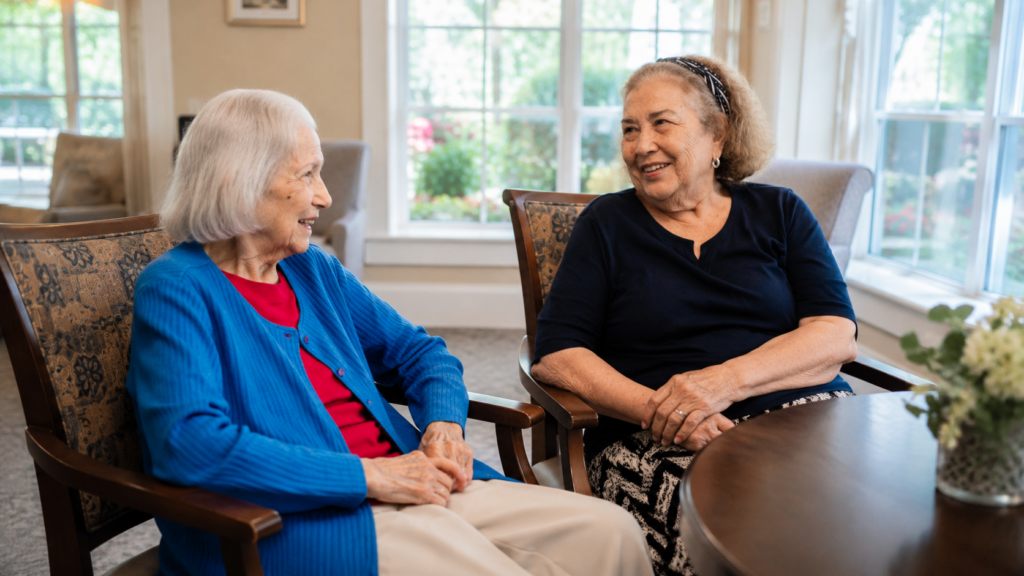
The two of them meet at the same table every morning. One arrives a few minutes early to save the seat by the window; the other brings a book she rarely opens because they always end up talking instead. They didn’t know each other a year ago. Now their families joke that you can’t reach one of them by phone before 10 a.m.
Stories like this play out quietly in senior living communities every day, and they’re easy to overlook. But underneath the morning coffee and the saved seat is something researchers have spent decades trying to measure: friendship in senior living communities may be one of the most powerful factors in how well a person ages, and one of the most underappreciated reasons families ultimately feel at peace with their decision to move a loved one into a community.
This guide is for you, whether you’re considering senior living for yourself, helping a parent navigate the next chapter, or simply trying to understand what makes a community feel like home.
Why Is Friendship Important in Senior Living Communities?
Friendship in senior living communities supports mental, physical, and emotional health by easing loneliness, reducing the risk of cognitive decline, and providing older adults with a daily sense of purpose. Research from the Harvard Study of Adult Development, one of the longest studies of adult life ever conducted, found that the quality of close relationships is the single strongest predictor of long, healthy, happy lives, more than diet, exercise, or wealth.
Why Friendship Becomes More Important With Age
Younger adults often take their social circles for granted. Coworkers, neighbors, friends from college, members of a gym or place of worship—connection is woven into the routines of daily life. In later years, that weave begins to loosen, often quietly, often without anyone noticing until the silence becomes hard to ignore.
Retirement removes the daily contact of colleagues. Adult children move away and start families of their own. Longtime neighbors downsize. Spouses and lifelong friends pass on. None of these losses are anyone’s fault, but together they can leave an older adult with a social world that has quietly contracted to a fraction of what it once was.
The numbers reflect what families often see firsthand. According to the National Academies of Sciences, Engineering, and Medicine, nearly one in four adults aged 65 and older is considered socially isolated. The U.S. Surgeon General’s 2023 advisory on loneliness called social disconnection a public health crisis, noting that its mortality risk is comparable to smoking up to 15 cigarettes a day.
If you’ve watched a parent’s calendar empty out over the years, none of this will surprise you. What may surprise you is how much can change when the right environment surrounds them again.
The Health Benefits of Friendship in Senior Living Communities
When older adults have regular, meaningful contact with people they trust, the effects show up across nearly every measure of well-being.
| Area of Well-Being | Aging in Isolation | Aging in a Connected Community |
| Cognitive Health | ~50% increased risk of dementia (CDC) | Slower cognitive decline; sharper memory and recall |
| Heart Health | 29% higher risk of heart disease, 32% higher risk of stroke | Lower blood pressure and reduced inflammation |
| Longevity | Higher mortality risk, comparable to heavy smoking | 50% greater likelihood of longevity (Holt-Lunstad meta-analysis) |
| Mental Health | Higher rates of depression and anxiety | Stronger emotional resilience and sense of purpose |
Conversation itself is a workout for the brain. Recalling a name, following a story, finding the right word, sharing a laugh—these are the small cognitive lifts that, repeated daily, help keep the mind nimble. The body responds in kind, with stronger immune function, better sleep, and faster recovery from illness or surgery, according to the National Institute on Aging.
But the deepest benefit is harder to quantify. Friendship gives older adults the feeling of mattering to someone. A friend who notices when you skip breakfast. A neighbor who asks how your daughter’s surgery went. A walking partner who counts on you to show up. These are the small, daily reminders that you are seen, known, and needed, and they are among the most protective forces against the quiet despair that isolation can bring.
How Senior Living Communities Make Friendship in Later Life Easier
One of the most underappreciated benefits of senior living is structural: the design of the community itself makes connection more likely. You don’t have to engineer it. You don’t have to push your parent to “put themselves out there.” The environment does much of the gentle work for you.
Built-In Proximity and Shared Routines
Friendship rarely happens by appointment. It happens through repeated, low-pressure contact: passing each other in the hallway, sitting near someone at dinner three nights in a row, ending up in the same elevator. Senior living communities re-create the proximity that careers, school pickups, and neighborhood ties once provided.
Programming Designed Around Connection
A well-run community offers a wide menu of ways to spend the day with others:
- Group fitness and wellness classes that double as social hours
- Interest-based clubs for everything from book lovers to woodworkers
- Cultural and religious programming that brings together residents who share a heritage or tradition
- Outings, lectures, and live performances that create shared experiences
- Volunteer and intergenerational programs that connect residents with the broader community
The activities matter less than what they create: a reason to be in the same room, doing the same thing, with the same people, on a regular basis.
Staff and Community Culture as Social Catalysts
The best communities don’t leave friendship to chance. Thoughtful team members notice when a resident is sitting alone at meals, when a newcomer hasn’t found their footing, or when someone who used to attend Tuesday bingo has gone quiet. A warm introduction from a trusted staff member can be the bridge that turns a stranger into a familiar face, and a familiar face into a friend.
What Makes Friendships in Senior Living Different
Friendships formed in this stage of life often surprise people with how quickly they deepen. Residents share a life stage—retirement, loss, changing health, adult children with busy lives—and that shared context creates an immediate baseline of understanding. There’s more time for unhurried conversation, and fewer pretenses; by this point in life, most people have stopped performing.
Not every meaningful relationship in a community is between residents, either. Many older adults form deep bonds with the team members who care for them, with visiting grandchildren, and with younger volunteers. These intergenerational friendships add a different texture to daily life—one that reminds residents they are part of a continuing story, not separated from it.
A retired teacher who arrived quiet and uncertain after her husband’s death found her people in the Wednesday afternoon writing group. A year later, she leads it. A man who hadn’t expected to make new friends “at his age” struck up a conversation with a neighbor in the elevator about a baseball cap; they’ve watched every game together since. These aren’t dramatic stories. That’s the point. Friendship in senior living tends to be built out of small, ordinary moments that, over time, add up to something extraordinary.
Overcoming the Barriers to Making New Friends Later in Life
It would be dishonest to suggest that connection comes easily to everyone. For many older adults, making new friends takes real courage. If your loved one is hesitant, please know that hesitation is not a flaw. It’s often the most human response to a season of life that has asked a lot of them.
Residents who have lost a spouse or close friends sometimes hesitate to invest in new relationships. Hearing loss can make group conversations exhausting. Mobility limits can shrink the radius of daily life. The good news is that meaningful friendship doesn’t require a packed calendar—it requires one or two people who genuinely know you.
For residents who want to broaden their social world, the smallest steps are often the most effective:
- Sit at a different table at lunch once a week
- Choose one activity that genuinely interests you and commit to attending three times before deciding whether to continue
- Ask a neighbor about something visible in their apartment—a photo, a piece of art, a book on the shelf
- Offer a small kindness without expectation
- Let staff know you’re open to meeting people; a good team will help
How Families Can Support a Loved One’s Social Life
If you’re the adult child researching senior living on a parent’s behalf, please hear this: you have more influence on your loved one’s social experience than you may realize.
- On tours, look beyond the amenities. Watch how residents interact with one another and with staff. Listen for laughter in the dining room. Ask current residents how they made their first friend in the community.
- Encourage without pushing. A parent who feels nudged may dig in their heels. A parent who feels supported is more likely to take the leap.
- Stay involved, but leave room for a loved one to build a life that isn’t centered on you.
- Watch for signs of thriving. New names in phone calls. Plans you didn’t make for them. A quiet contentment that wasn’t there before.
Final Thoughts on Friendship and the Aging Experience
The two residents at the window table didn’t plan to become close. They simply lived in a place where the conditions for friendship were right—proximity, time, a shared rhythm of days, and a community that made it easy to stop and stay a while.
The right senior living community doesn’t just provide care. It provides the soil in which connection can take root and grow. For older adults navigating a season of life that often involves loss, that soil can make the difference between simply getting older and genuinely living well.
Finding a Community Where Connection Comes Naturally: Cura Living
At Cura Living, we believe friendship isn’t an amenity. It’s part of the care.
Our communities are built around the conviction that every resident deserves to be known, not just looked after. We don’t hire staff so much as invite companions, because the people who walk our hallways every day shape the experience of everyone who lives there. That philosophy shows up in small, consistent ways: in the team member who remembers how you take your coffee, in the neighbor who saves you a seat, and in the program calendar that reflects the heritage and traditions of the people we serve, including kosher dining and culturally responsive offerings at our Boca Raton community.
If you’re exploring senior living for yourself or someone you love, we’d be honored to walk alongside you. Schedule a visit, take a tour of one of our communities, or simply have a conversation with a member of our team about what you’re looking for. We earn trust through action, and we’d rather you feel the difference for yourself than take our word for it.